
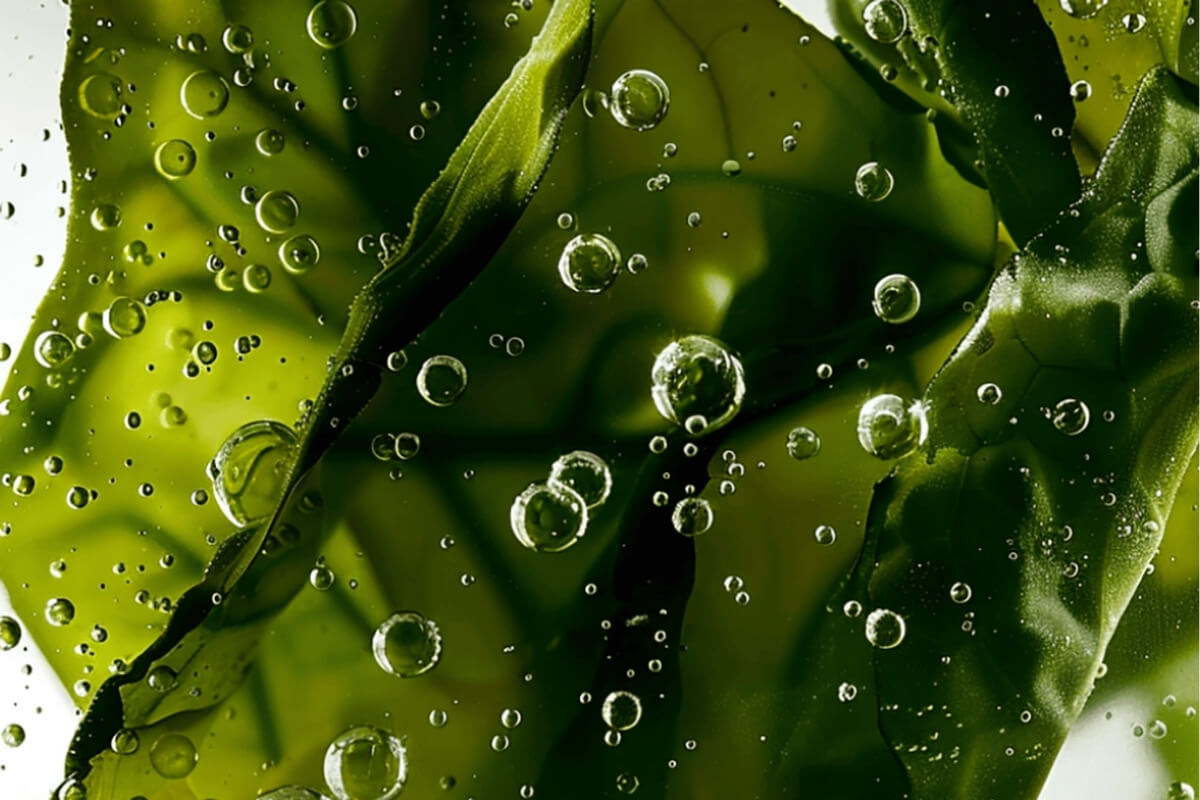
They grow in the sea, in lakes, and in rivers and have adapted to a wide variety of environmental conditions over millions of years.
Many types of algae develop substances that protect them from intense sunlight, salt, dry periods, or oxidative stress.
Precisely these properties make algae interesting for skin care today. Depending on the type, they contain antioxidants, minerals, trace elements, vitamins, or polysaccharides, among other things: substances that can be specifically used in cosmetic formulations.
What algae can do for your skin
When talking about algae, it initially sounds like a single ingredient. However, the term actually encompasses thousands of different species. Each has its own composition and is therefore used differently in cosmetics. Algae are rich in vitamins, minerals, antioxidants, and trace elements. Depending on the type, they have different effects, but they have one thing in common: they strengthen, protect, and regenerate the skin.
- Red Algae (Porphyra umbilicalis): Has an antioxidant effect and protects against light-induced skin aging.
- Brown Algae (Undaria pinnatifida): Stimulates collagen and elastin production, ideal for smoother, firmer skin.
- Green Algae: Supports cell renewal and strengthens the skin barrier.
Therefore, it is always worth taking a look at which algae extract is actually contained in a formulation, and not just whether algae are used at all.
How hyapur® uses the power of algae
In skin care, algae extracts are often combined with hyaluronic acid. Both ingredients fulfill different tasks. While hyaluronic acid stores moisture, algae, for example, have an antioxidant and regenerating effect. This creates a synergistic effect that not only nourishes but actively strengthens the skin.
Antioxidant protection
Some types of algae contain natural antioxidants. They help to neutralize free radicals, which can be caused by UV radiation and environmental pollution, among other things. Antioxidants are therefore an important component of many healthy aging concepts. You can find antioxidant protection in the Yellow Serum from the Hyaluron-Algae series.
Support for moisturization
Certain polysaccharides from algae can help to bind moisture to the skin's surface and promote a pleasant skin feeling. You can find this effect in the Red Serum.
Skin barrier care
Some algae extracts are also used to make the skin supple and to support the function of the natural skin barrier. Dry skin, in particular, often benefits from a combination of moisture and barrier-strengthening care. This is how the Green Serum also works.
Nature meets formulation science
Sometimes it seems as if natural ingredients and scientifically developed skin care are opposites. In fact, both approaches are not mutually exclusive. What is decisive is not whether an ingredient is of plant or synthetic origin. What is decisive is what role it plays in the formulation and how well it has been studied. Algae are a good example of this. They are natural raw materials, but their use in modern skin care products is based on cosmetic research and a targeted selection of suitable extracts.
Fewer trends, more function
Algae are often referred to as "superfood" or "super substance." While such terms sound impressive, they say little about the actual effect in a formulation. The more meaningful question is: What contribution does this ingredient make to the skin? With algae, the answer is often: Depending on the type, they can support the skin with antioxidant, moisturizing, or nourishing properties and thus complement a balanced skin care routine.