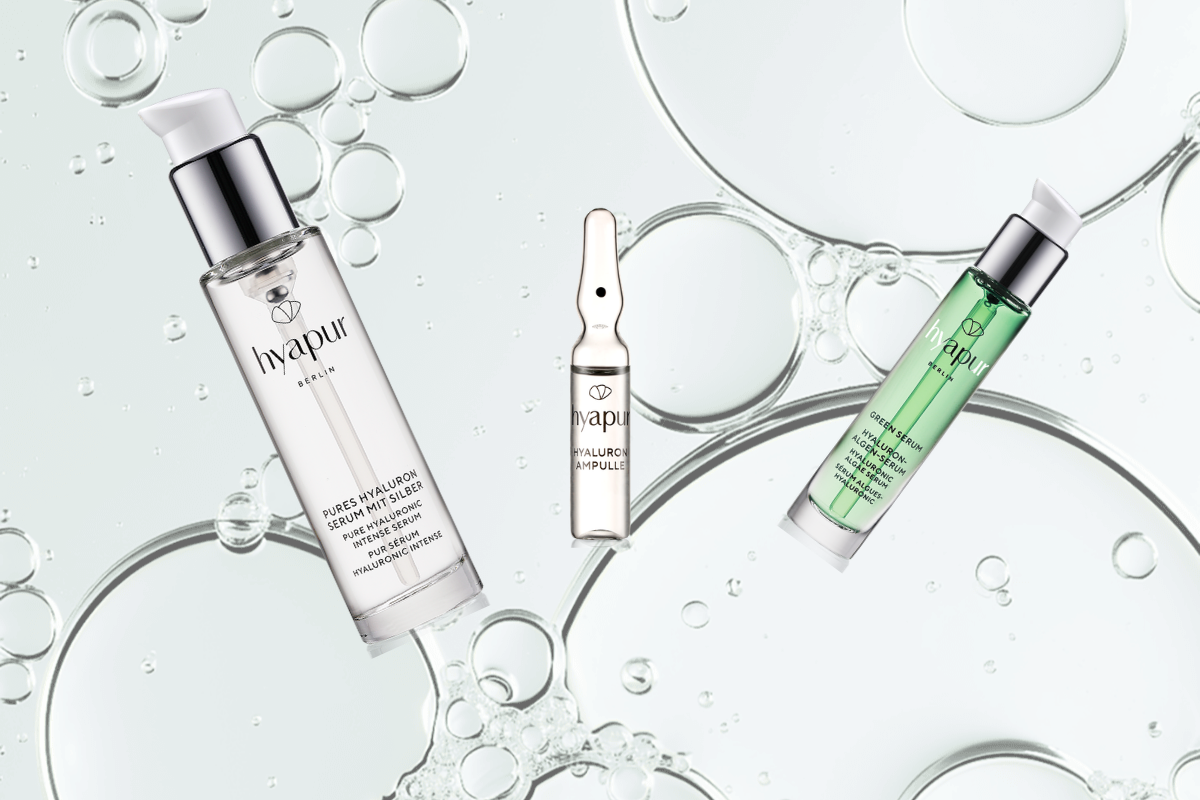


As hyaluronic acid experts, we at hyapur® Berlin are often asked: Which hyaluronic acid is the best? The short answer: It depends.
The long answer is much more exciting, because in our opinion, there isn't "the best" hyaluronic acid. Instead, the ideal choice depends on your skin type, your skin condition, and your goal.
What is hyaluronic acid anyway?
Hyaluronic acid is a substance that occurs naturally in the human body. Among other things, it is a component of the skin and has the ability to bind large amounts of water.
As we age, the natural hyaluronic acid content of the skin decreases. As a result, the skin is less able to store moisture and often appears drier. That's why hyaluronic acid is now one of the most well-known moisturizing active ingredients in skincare.
Why are there different types of hyaluronic acid?
Hyaluronic acid differs primarily in its molecular size. The most common distinction is between high-molecular and low-molecular hyaluronic acid. Both variants fulfill different functions.
High-molecular hyaluronic acid
High-molecular hyaluronic acid primarily remains on the skin's surface. There, it supports the moisture supply of the upper skin layers and contributes to a pleasantly nourished skin feeling.
It is often used in products that are intended to immediately provide the skin with moisture.
Low-molecular hyaluronic acid
Low-molecular hyaluronic acid has smaller molecules. It is therefore often used in formulations that are aimed at intensive moisturization.
However, the ultimate properties of a product always depend on the entire formulation, not solely on the molecular size.
Which hyaluronic acid is better now?
Our honest answer is: Neither is better or worse. Both forms have their justification; the crucial question is rather: What should the product achieve?
Hyaluronic acid according to skin needs
Depending on the skin's needs, different forms of hyaluronic acid work differently well:
- Dry skin: benefits from high- and low-molecular hyaluronic acid, preferably in combination
- Mature skin: requires deeply effective, low-molecular hyaluronic acid
- Sensitive skin: prefers simple, irritation-free formulations
Short-term effect vs. long-term effect
Some hyaluronic acid products deliver immediately visible results, such as a smooth complexion. Others work long-term by improving skin structure. The "best" hyaluronic acid also depends on whether you:
- want immediate results
-
or are looking for sustainable skin improvement
The formulation is more important than a single active ingredient
In skincare, there is often a search for the "best" ingredient. However, the effect of a product almost never comes from a single component. Much more important is the interaction of all ingredients. Questions that play a role here?
- Which form of hyaluronic acid is used?
- In what concentration?
- With which other ingredients is it combined?
- For which skin need was the formulation developed?
Why hyapur® relies on a clear formulation
We believe that a formulation is best when every ingredient fulfills a comprehensible purpose.
The most effective products focus on high-quality, highly concentrated hyaluronic acid or combine different types of hyaluronic acid. This combination creates a multidimensional effect:
- the skin's surface is visually smoothed
- deeper skin layers are hydrated
- with regular use, the skin structure is strengthened
What does this mean for your skincare?
If you're looking for the "best" hyaluronic acid, it's worth changing your perspective. Molecular size alone doesn't determine the quality of a product. More important is the question: Does the formulation suit my skin's needs?
Because a well-thought-out combination of moisture, supporting ingredients, and a clear formulation often benefits the skin more than a single trend ingredient.
Our conclusion: It's all about the combination
Hyaluronic acid is one of the most important moisturizing active ingredients in modern skincare. Whether high- or low-molecular, both forms fulfill different functions. The decisive factor is not which variant is used, but how it is integrated into a well-thought-out formulation.
Because good skincare doesn't start with the search for the best individual active ingredient. But with an understanding of how ingredients work together.