

Skincare during menopause: What your skin really needs now
During menopause, hormonal balance shifts, and with it, often your skin as well. It may become drier, thinner, and more sensitive, or unexpectedly prone to breakouts again. Perhaps it feels tight after showering, fine lines are more noticeable, or your usual skincare routine no longer feels as suitable as it once did.
These changes do not mean that your skin is getting worse. Rather, its biological requirements are changing, and with them, its needs.
Here you will learn (in simplified terms) what role estrogen plays for the skin, why it may sometimes struggle to retain moisture from around the age of 40 or 45, and how you can support your skin during menopause with a thoughtful healthy-aging routine.
Please note: This article provides general information on skincare and is not a substitute for medical advice. If you have any concerns or questions regarding hormonal changes, your gynecologist is the right person to contact.
01 What happens to the skin during menopause
The menopause encompasses perimenopause, menopause, and the subsequent postmenopause. During this phase of life, hormone levels change. For most women, it begins between their mid-40s and early 50s. A declining estrogen level, in particular, can affect various processes in the skin.
Common changes include:
- Dryness and a feeling of tightness: The skin may struggle to retain moisture and feel rougher.
- Reduced elasticity: Changes in collagen and elastin can contribute to the skin appearing less firm.
- A more sensitive skin barrier: The skin may react more strongly to cleansing, weather, or certain skincare products.
- Fine lines: With dry skin, lines can become more prominent.
- Altered sebum production: Some women experience increased dryness, while others may simultaneously face blemishes or a greasier T-zone.
- Pigmentation changes: Pre-existing UV-induced pigment spots can become more visible.
Not every woman experiences all of these changes. The timing and extent are also individually variable.
02 What role does estrogen play for the skin?
Estrogen influences various processes that are important for the structure, moisture, and regeneration of the skin. These include, among other things, the activity of fibroblasts, the cells that produce components of the extracellular matrix such as collagen.
Estrogen is also linked to skin hydration, skin thickness, and other properties of skin tissue.
During menopause, estrogen levels drop. This can change these processes:
- Collagen production decreases.
- The body's own hyaluronic acid and the skin's ability to retain water may decline.
- The amount and composition of the skin's own lipids can change.
- The skin may lose elasticity and become more sensitive to external influences.
These changes do not occur in the same way for all women. Age, genetic factors, UV exposure, lifestyle, and individual skin condition also play a role.
Important: Cosmetic skincare cannot reverse hormonal changes. However, it can help to hydrate the skin, support its barrier, and reduce additional stressors.
03 Why does skin retain less moisture after age 40 or 45?
Many women notice from their mid-40s that their skin is becoming drier, feels tighter after cleansing, or that fine lines are becoming more pronounced. This is not exclusively due to menopause. General age-related changes can also contribute to this.
The interplay of several moisture systems in the skin is decisive.
Hyaluronic acid: A natural water binder
Hyaluronic acid occurs naturally in the skin. It can bind large amounts of water and helps ensure that the tissue remains well hydrated.
With increasing age, the amount and distribution of the body's own hyaluronic acid can change. In connection with other changes, this can make the skin appear less plump and less able to retain moisture.
Hyaluronic acid in cosmetic care products can bind water in the upper layers of the skin, thereby improving how the skin feels. However, it does not replace the body's own hyaluronic acid and does not completely compensate for age-related changes.
Skin lipids: The protective mortar between skin cells
The outer layer of our skin can be simplified as a wall: the skin cells are the bricks, the lipids between them the mortar.
These lipids include ceramides, cholesterol, and fatty acids, among others. They help keep the skin barrier intact and limit water loss. If the composition of the lipids changes or the barrier is compromised, water can escape from the skin more easily. The skin then often feels dry, rough, or tight.
Natural moisturizing factors: Binding water in the stratum corneum
Besides hyaluronic acid, the skin possesses other natural moisture systems. The so-called Natural Moisturizing Factors (NMF) consist of various substances, including amino acids, urea, and components of amino acid metabolism.
They help to keep water in the stratum corneum and make it supple. If the amount of these substances or the conditions of the stratum corneum change, the skin may feel drier.
The skin barrier needs support
The renewal and regeneration of the skin also change with increasing age. If the skin is additionally stressed, for example by intensive cleansing, dry heating air, wind, or UV radiation, it may require more support.
An important term here is transepidermal water loss (TEWL). It describes how much water is released outward through the skin. If the barrier function is impaired, this water loss can increase.
This means for skincare: Dry skin does not just need moisture. It also needs support in retaining this moisture.

Hyaluronic Acid
Click here for our hyaluronic acid guide.
04 What skin needs during menopause
A good skincare routine does not have to become more complicated during menopause. Often, it is more sensible to reset your priorities:
hydration, barrier protection, gentle cleansing, and consistent UV protection.
01 Gentle Cleansing
A gentle cleanser removes dirt, sunscreen, and makeup without unnecessarily stressing the skin.
If your skin increasingly feels tight or reacts sensitively, it is worth avoiding very aggressive cleansing products and excessive cleansing.
02 Hyaluronic Acid Serum as a hydration base
Moisturizing factors such as hyaluronic acid or glycerin can bind water in the upper layers of the skin and improve skin feel.
A serum can be a useful part of your routine for this purpose. However, for dry skin, it does not necessarily replace a subsequent cream, which provides additional nourishing lipids and limits moisture loss.
03 Day / Night Care
Skincare products with suitable lipids can help to support the skin barrier. Depending on the formulation, ingredients such as ceramides, fatty acids, or other skin-conditioning lipids may be used for this purpose.
Which texture is suitable depends on the skin condition: very dry skin often benefits from richer products, while combination skin may prefer lighter formulations.
04 Use sun protection daily
UV radiation contributes significantly to premature skin aging. It can damage collagen structures and promote pigment changes.
Broad-spectrum sun protection with an appropriate sun protection factor is therefore an important component of a healthy aging routine – regardless of whether the skin is currently dry or sensitive.
05 How does skincare change after 45?
Perhaps you have hardly changed your skincare routine for years and are now finding that your skin has different needs. This does not automatically mean that you have to replace all your previous products.
It often helps to review your routine in a targeted manner:
- More hydration: Add a suitable moisturizer if needed.
- More barrier protection: Pay attention to whether your current cream provides enough care.
- Fewer unnecessary irritants: Check whether intensive exfoliants or multiple active ingredients at the same time are really necessary.
- Gentle cleansing: Avoid products that leave your skin feeling tight on a regular basis.
- Consistent sun protection: Protect your skin from UV radiation daily.
Introduce new products one at a time if possible. This allows you to better observe how your skin reacts.
A short INCI list is not an automatic hallmark of quality. The formulation, the function of the ingredients, and individual tolerance are the deciding factors.
06 Healthy Aging instead of anti-aging: understanding the skin, not fighting it
Menopause is not a point in time when the skin needs to be repaired. It is a phase of life in which its biological conditions and needs change.
Healthy aging means understanding these changes and supporting the skin in a meaningful way. This includes proper hydration, an intact skin barrier, protection against UV radiation, and a skincare routine based on the actual condition of the skin.
It is not about preventing every wrinkle or using as many active ingredients as possible. It is about keeping the skin healthy in the long term and giving it what it needs.
Fewer products, more understanding:
A calm, consistent routine can be more helpful than frequent product changes. After all, not every change requires a new cream. Sometimes the skin primarily needs hydration, barrier protection, and a little patience.
FAQs
07 Frequently Asked Questions about Skin and Menopause
Does the skin really change during menopause?
Yes. The declining estrogen level has a direct effect on the skin's production of collagen, elastin, and hyaluronic acid. Studies indicate that the skin loses a noticeable portion of its collagen in the first years after menopause, causing it to become thinner, drier, and less elastic.
Why does skin become drier during menopause?
Several factors can interact: changes in the body's own hyaluronic acid, natural moisturizing factors, and the skin's own lipids can contribute to the skin being less effective at retaining water. A compromised skin barrier can further increase transepidermal water loss.
Can skincare compensate for a hormone deficiency?
No. Cosmetic skincare cannot influence your hormone balance. However, it can mitigate the external effects by providing moisture, strengthening the skin barrier, and protecting the skin from further dehydration. Questions regarding the hormonal transition itself should be addressed by a doctor.
At what point should I adjust my skincare for menopause?
There is no fixed time. Skin changes often begin as early as perimenopause, i.e., several years before the final menstrual period. As soon as you notice increased dryness, a feeling of tightness, and a loss of elasticity, it is worth adjusting your routine.
Why am I suddenly getting breakouts again during menopause?
Because estrogen levels drop faster than other hormones, the ratios can shift temporarily. This can stimulate sebum production and lead to blemishes, similar to puberty.
Does hyaluronic acid help with moisture loss during menopause?
Hyaluronic acid can bind externally applied moisture, thereby alleviating the tight sensation of dry skin. However, it cannot replace the body's own production, but instead provides the skin with additional external support.
Is my current anti-aging skincare still sufficient?
That varies from person to person. Many women report that their previous skincare routine no longer provides sufficient moisture during menopause. A good first step is often to add a highly concentrated hyaluronic serum, instead of changing your entire routine.
Do I need to use more skincare products from the age of 45?
No. Often it makes more sense to specifically adjust your existing routine rather than adding many new products. A gentle cleanser, a suitable moisturizer, an appropriate cream, and sun protection form a good foundation.
Read more: more about hyaluronic acid and skincare
Warum Hautpflege auch ein Ritual sein darf
Hautpflege beginnt mit der richtigen Reinigung, einer passenden Feuchtigkeitspflege oder einer Creme, die die Hautbarriere unterstützt. Doch sie kann noch etwas anderes sein: Ein kleiner Moment nu...
How often should you change your skincare routine?
On social media, it is often suggested that skin "gets used to" a cream if the same one is used for months. However, the truth is that our skin does not develop a habituation to skincare to this ex...
Sleep, Diet, and Stress: How They Affect Our Skin
Many of us primarily associate beautiful skin with the right skincare. Serums, creams, and active ingredients often take center stage. Yet, it is easy to forget that our skin is not an isolated organ.
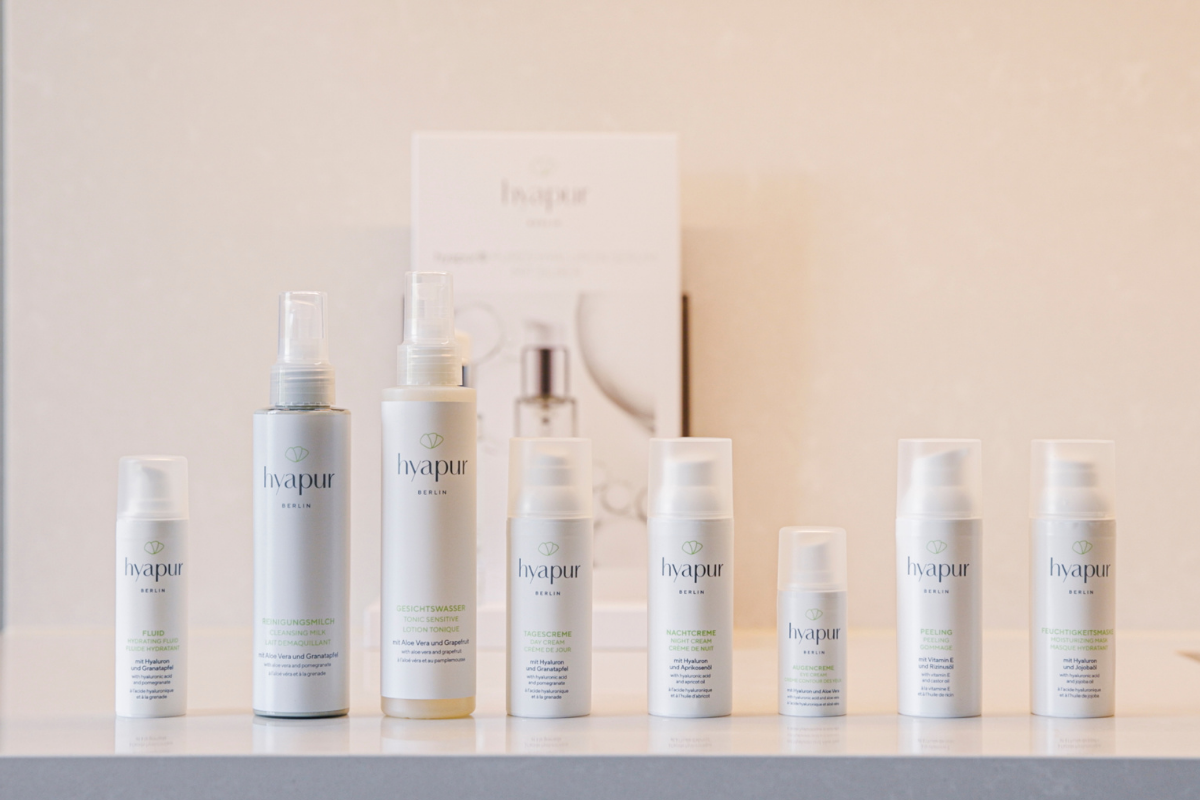
hyapur® Berlin
Your skincare over the years
Take your time browsing our shop to see what a healthy aging routine with hyapur® could look like. Do you have any questions? We would be happy to advise you free of charge and, of course, with no obligation to buy, via telephone or email.
About hyapur® Berlin

- Since 2009, the brand for premium hyaluronic cosmetics
- vegan, biotechnologically produced hyaluronic acid and natural formulations reduced to the essentials
- Quality Made in Germany

- over 1,000 delighted customers
- Spa partner of the Mein Schiff® fleet, Hapag-Lloyd Cruises, selected ROBINSON Clubs and 5-star hotels