

Many people initially associate lactic acid with food or metabolism. But it also plays an important role in our skin. As a component of the natural moisturizing factor (Natural Moisturizing Factor, NMF), it helps retain water in the outermost layer of the skin and keeps the skin supple.
In modern skincare, lactic acid is therefore a versatile ingredient. It can moisturize, smooth the skin's surface and, depending on the concentration and formulation, support the skin's natural renewal.
What exactly lies behind this active ingredient is explained below.
What makes lactic acid so special?
Lactic acid (INCI: Lactic Acid) belongs to the group of alpha-hydroxy acids (AHAs). These are organic acids that occur in various plants, foods and also in the human body.
In our skin, lactic acid (or lactate) is a natural component of the Natural Moisturizing Factor. This consists of various water-binding substances, including amino acids, urea, salts and organic acids.
Together, these components ensure that the outermost layer of the skin can retain sufficient moisture. This is important for keeping the skin smooth, elastic and supple.
The effect of lactic acid on the skin
Lactic acid fulfills several functions in skincare:
- Moisture retention: As a component of the natural moisturizing factor, lactic acid supports the stratum corneum's ability to retain water. This can help drier skin stay more supple.
- Gentle skin renewal: As an alpha-hydroxy acid, lactic acid can loosen dead skin cells on the surface. This supports natural desquamation and can make the skin appear smoother and more even.
- Support of the skin barrier: Studies show that lactate may be involved in the formation of ceramides. These lipids are important components of the skin barrier and help limit moisture loss.
- Support of the skin's natural pH level: Lactic acid can help establish a skin-friendly pH level in cosmetic formulations. A slightly acidic environment is important for the function of the skin barrier.
The interplay of these properties is particularly interesting: lactic acid can not only care for the skin's surface but is also involved in natural processes that are important for the skin's moisture balance and barrier function.
Lactic acid and AHA: More than a peeling ingredient
When lactic acid is mentioned, many people think of chemical peels. In fact, it is frequently used in such products due to its keratolytic properties. As an AHA, it can help loosen the bonds between dead skin cells. This allows the outermost layer of the skin to be removed more evenly. The result can be a smoother skin surface and a fresher appearance.
However, the effect depends heavily on the concentration, pH level and overall formulation. In low-dose, appropriately formulated skincare products, lactic acid can primarily help moisturize. Higher concentrations and a lower pH level enhance the exfoliating effect. Lactic acid is therefore not automatically equated with an intensive peel. What matters is how it is used in a product.
Lactic acid and hyaluronic acid: A sensible combination
Lactic acid and hyaluronic acid pursue a similar goal: they support the skin's moisture balance, but in different ways.
Hyaluronic acid is a particularly powerful moisture binder that can bind water to itself. It is used in skincare to supply the upper layers of the skin with moisture and support a smoother skin feel.
Lactic acid or lactate, on the other hand, is a component of the skin's natural moisturizing factor. It supports water retention within the stratum corneum and can also contribute to skin renewal. In a well-thought-out skincare formula, these properties can complement each other effectively.
While hyaluronic acid supports moisture supply, lactic acid helps maintain the skin's natural moisturizing processes.
For which skin type is lactic acid suitable?
Lactic acid is a versatile ingredient used in both moisturizing skincare and exfoliating products. It can be particularly interesting for:
- Dry skin: As a component of the NMF, it supports natural moisture retention.
- Rough and dull skin: Its exfoliating properties can help loosen dead skin cells and smooth the skin's surface.
- Demanding skin: Due to its combination with natural moisturizing factors and skin lipids, it is an interesting component of a balanced moisturizing treatment.
For sensitive skin, the formulation also matters. A low concentration and a correspondingly adjusted pH level can improve tolerance. Nevertheless, lactic acid, especially in exfoliating products, can cause temporary stinging or irritation. Therefore, special caution is advisable with an already irritated or damaged skin barrier.
The application of lactic acid in skincare
Lactic acid can be found in various cosmetic products, such as creams, serums, face masks and peels.
How often and in what form it should be used depends on the respective product and its concentration. Exfoliating AHA products should initially be carefully integrated into the skincare routine. Since AHAs can increase the skin's photosensitivity, adequate sun protection during the day is important.
In moisturizing skincare products, lactic acid can fulfill a different function: here, exfoliation is not necessarily the focus, but rather its role as a component of the natural moisturizing factor.
What matters, therefore, is not the ingredient alone, but its concentration and its interplay with the other components of the formula.
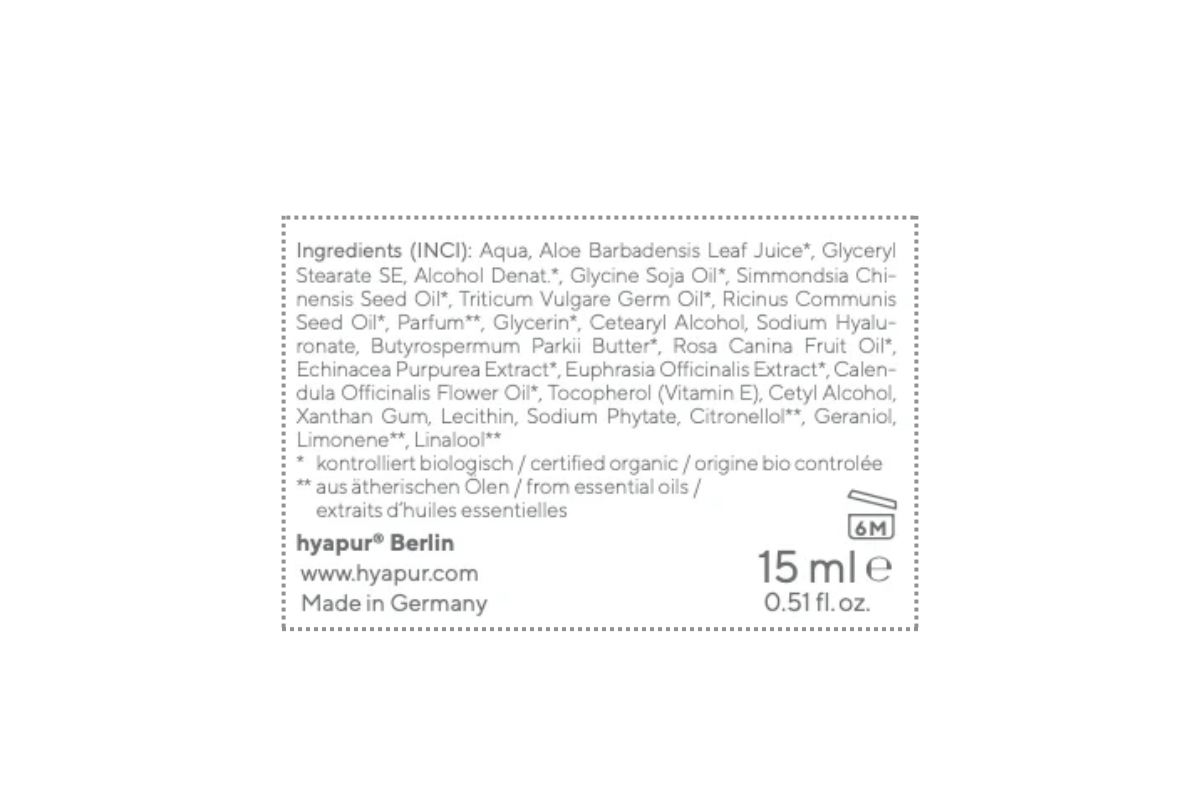
Lactic acid in the hyapur® GREEN series
Lactic acid is included in four products from our GREEN series: the exfoliant, the moisturizing mask, the day cream, and the night cream. You can find more information about all the ingredients in our ingredient glossary.