
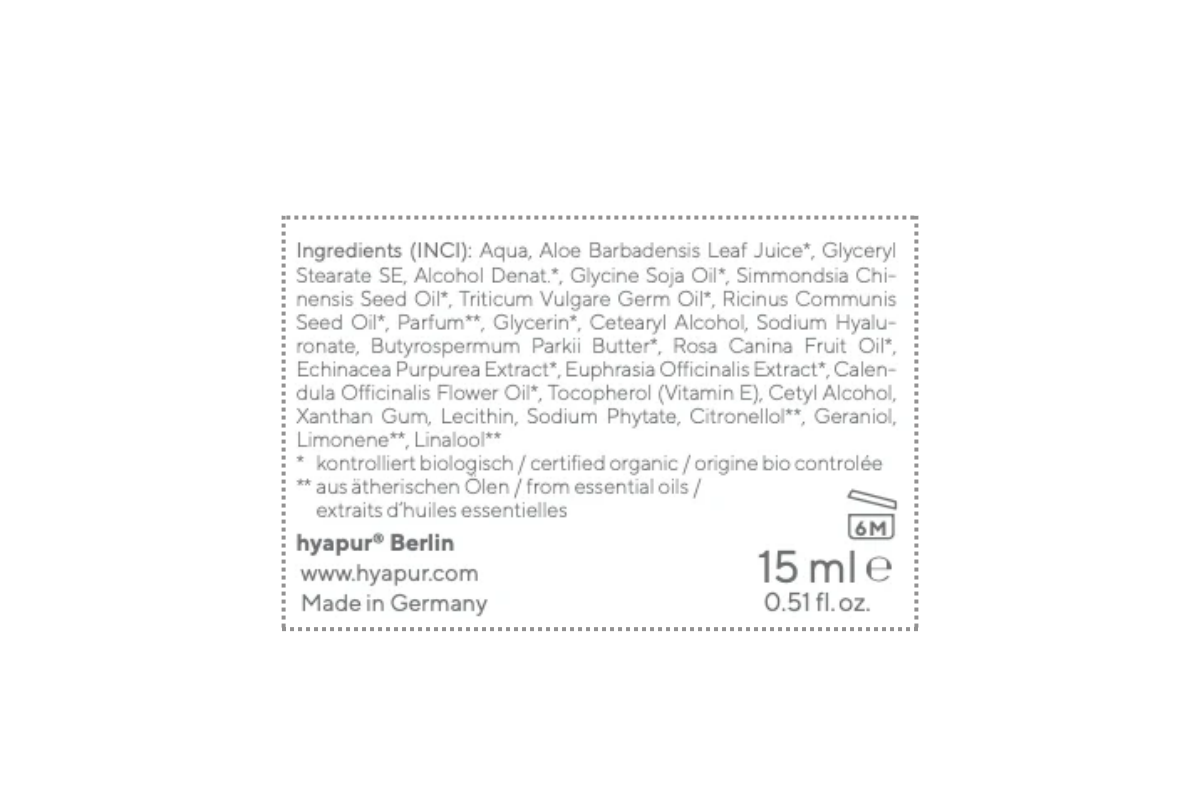
Aqua, Glycerin, Sodium Hyaluronate, Parfum: Anyone who has ever taken a closer look at the back of a cosmetic product knows the long lists of terms that at first glance seem to have little to do with skincare.
But reading an INCI list doesn't have to be complicated. If you know a few basic rules, you can quickly recognize which ingredients are in a product and what functions they roughly serve.
What does INCI even mean?
INCI stands for International Nomenclature of Cosmetic Ingredients, an internationally standardized designation for cosmetic ingredients.
In cosmetic products, the components are not listed by their common names, but by these standardized designations. That is why, for example, Aqua often appears instead of "water" or Sodium Hyaluronate instead of "hyaluronic acid".
The INCI list is therefore primarily one thing: a transparent listing of the ingredients of a product.
The order tells you something. But not everything.
One of the most important rules: Ingredients are generally listed in descending order of their weight percentage during manufacturing.
If Aqua is in first place, this means that water makes up the largest proportion of the formulation. But beware: the order does not automatically indicate which ingredient is the most effective.
Because an ingredient can be effective even at a relatively low concentration, while another serves primarily as a solvent or base for the formulation at a higher concentration.
In addition, ingredients with a proportion of less than 1% can be listed in any order. The first positions therefore provide guidance, but are not an active ingredient ranking.
Why are the ingredients named so complicatedly?
INCI names are standardized technical terms. This has a major advantage: an ingredient can be clearly identified internationally.
Sodium Hyaluronate, for example, refers to the sodium salt of hyaluronic acid. Even if "Hyaluronic Acid" is written on the front of a product, you will therefore usually find it in the INCI list as Sodium Hyaluronate.
At hyapur®, we distinguish, for example, between high- and low-molecular-weight hyaluronic acid. Both have the same INCI name, although they differ in terms of their molecular size and their properties in the formulation.
Get to know the most important ingredient groups
You don't need to know every single INCI name by heart. It is much more helpful to understand the most important functions.
Humectants
These include, for example, glycerin or hyaluronic acid. They help to bind water in the upper layers of the skin and keep the skin hydrated and supple. Hyaluronic acid belongs to the so-called humectants, i.e., moisture retainers.
Lipids and emollient components
Ceramides, plant oils, shea butter, or squalane can be part of a care product that supports the skin barrier and reduces moisture loss.
This is especially important for dry skin: providing moisture is only one part of skincare. The skin must also be able to retain this moisture as well as possible.
Plant extracts
Aloe Vera, algae extracts, or other plant-based components can fulfill different functions, for example, providing moisture or caring for the skin.
They are often listed with their Latin names.
Excipients
Not every ingredient is an active ingredient. Emulsifiers, thickeners, stabilizers, or preservatives, for example, ensure that a formulation gets its desired texture, remains stable, and can be used safely. This is important to understand: A long INCI list does not automatically mean a complicated or bad formulation.
What about Parfum or fragrances?
If you have sensitive skin or react to certain fragrances, it is worth taking a look at terms like Parfum and individual fragrances that must be declared.
For people with sensitive skin or skin prone to reactions, it can make sense to consider your own skin tolerance more than general statements about whether an ingredient is "good" or "bad".
Because skincare is individual.
So how do you best read an INCI list?
Instead of picking out individual ingredients, you can ask yourself three questions:
- What is the base of the formulation?
- What functions do the most important ingredients fulfill?
- Does the formulation contain components that I personally do not tolerate?
Because that is exactly what an INCI list should be about: not about recognizing as many ingredients as possible, but about understanding the formulation better.
Why a short INCI list can be interesting
At hyapur®, we deliberately pursue a minimalist approach: Every ingredient should have a comprehensible function in the formulation. The Pure Hyaluronic Intense Serum, for example, consists of only three ingredients: Aqua, Sodium Hyaluronate, and Silver. This does not mean that three ingredients are fundamentally better than twenty. It means: If a product has a very clear purpose, such as providing moisture, a reduced formulation can also make sense.